
The statue of the Redeemer, or more commonly the Christ of Maratea, dominates the city of Maratea, on top of Monte San Biagio.
Built to replace the commemorative cross placed in memory of the attack suffered by the ancient fortified citadel in 1806, the Christ is the work of Stefano Rivetti from Biella, who arrived in Basilicata in 1953.
As early as 1957 Rivetti had entrusted the project to the artist Bruno Innocenti, a professor at the State Institute of Art in Florence. The first sketches of the statue date back to 1960 and in 1964 it was entrusted to Eng. Luigi Musumeci the study and the structural and load bearing project of the structure.
Musumeci himself began the construction of the concrete and iron reinforcement, fixed to the foundations dug into the rock of the mountain with the use of over 14 tons of iron and in September of the same year he began the casting of marble and cement that would make up the body of the statue.
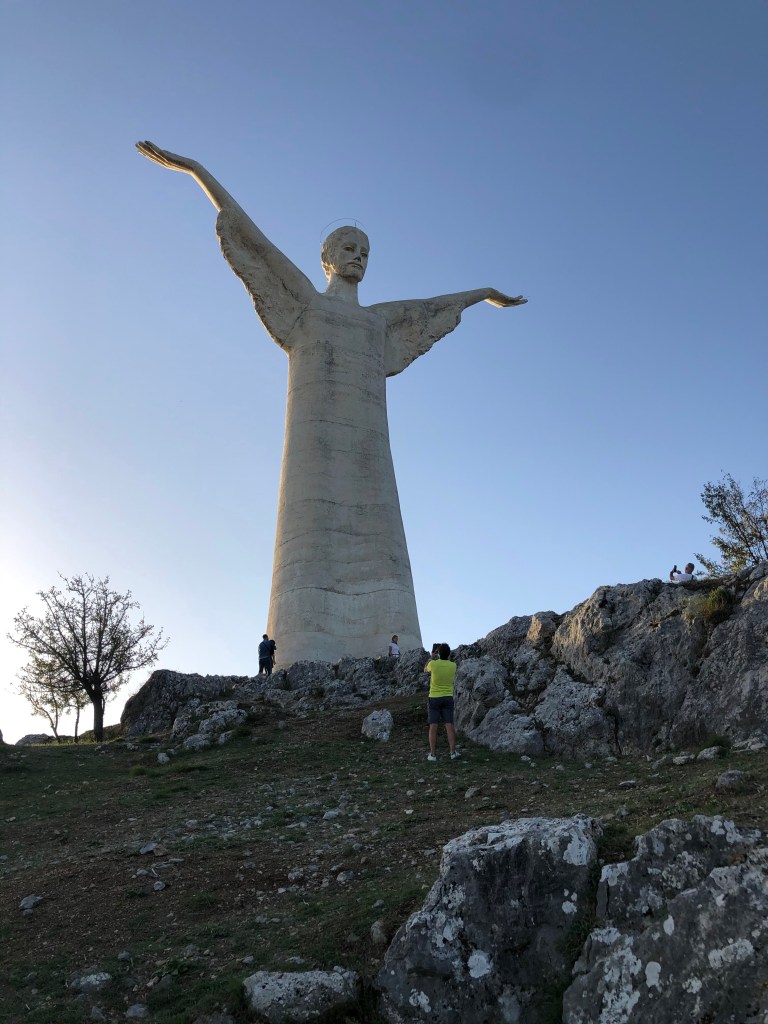
Between the end of 1964 and the first months of 1965, Bruno Innocenti carried out the chiselling of the entire surface of the sculpture.
The Redeemer of Maratea is the tallest statue of Christ in Europe and in the world, with its 21 meters in height, it ranks third (after that of Rio in Brazil, 38 meters and Cochabamba in Bolivia, 33 meters) .
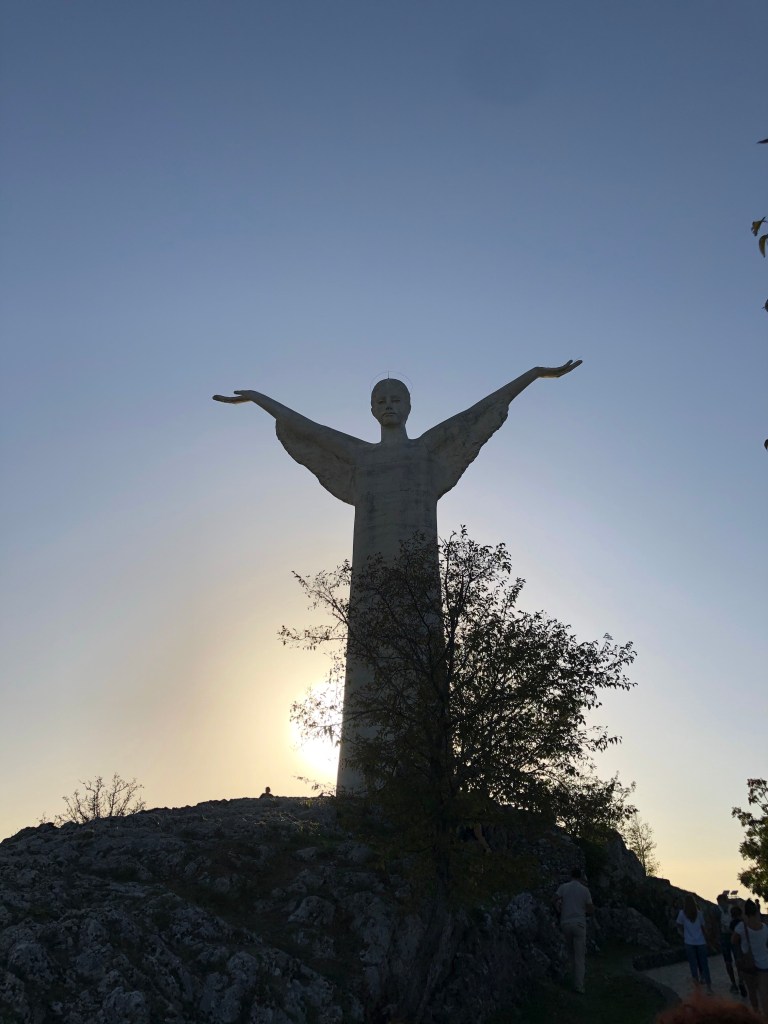
The monument stretches towards the sea overhanging for several hundred meters overlooking the port of Maratea and giving visitors one of the most evocative panoramic views of the area. The statue has its back turned towards the sea and its face towards the mainland, as if to watch over the inhabitants of Maratea and the territory.
Christ the Redeemer shows a young face and a barely hinted beard. It is in a position that seems to slowly advance with open arms towards the adjacent Basilica of San Biagio.
Compared to the classic iconography of Jesus it is conspicuously different, with short hair and barely hinted lips, in reference to a certain modernity. The raised and slightly bent arms ensure that in the distance nothing is revealed about the direction of the face.
Along the pedestrian path, slightly uphill, you pass through the ruins of the ancient Castle of Maratea, which was razed to the ground by the French after having capitulated following a long siege, in December 1806.
Along the entire route you can admire the wonderful panorama of Maratea. You have an exceptional 360 ° view of the magical profile of the Gulf of Policastro and of the inland mountains.
One of the most characteristic moments for visiting the statue of Christ the Redeemer is during the feast of San Biagio.

 Villanis Mario